How Can We Help You?
Please provide a few details below and we will respond to you as soon as possible.
Please provide a few details below and we will respond to you as soon as possible.

Cut edge corrosion is a familiar challenge for many building owners and facilities managers responsible for maintaining metal profiled cladding. It is most commonly associated with roof sheets, where constant exposure to rainwater, snow, ice, UV degradation and standing water accelerates the breakdown of the factory‑applied coating. Over time, the sheet edges begin to peel back, exposing bare metal that corrodes and spreads if left untreated.
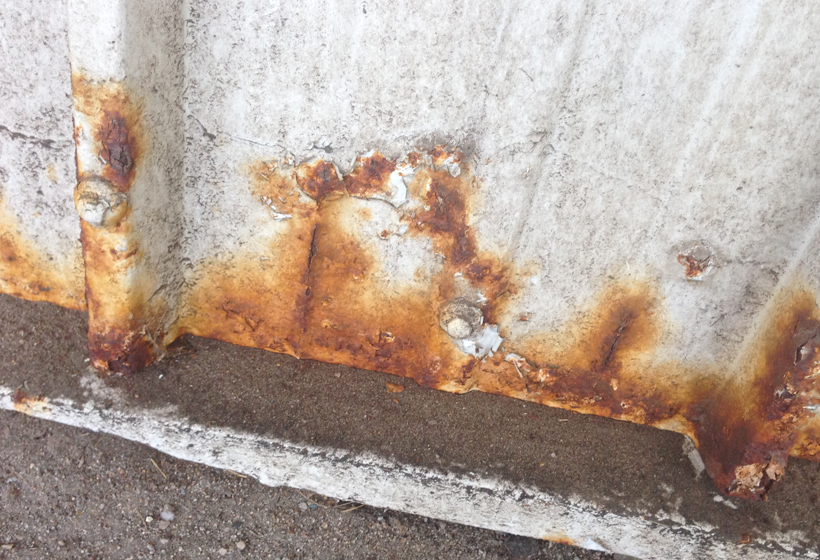
However, while roof areas are the typical location for this type of deterioration, cut edge corrosion can and does occur on wall cladding. Though less common, it is no less important to address. In fact, when corrosion appears on walls, it often signals unique environmental pressures or site‑specific conditions that require careful assessment and a tailored protective system.
One of our featured projects we completed was the Parcelforce depot in Aberdeen which provides a clear example of how and why cut edge corrosion can develop on wall cladding, and why specialist knowledge is essential to diagnose and resolve it effectively.
Why Wall Cladding Is Normally Less Susceptible
Metal wall cladding is generally more protected than roof sheets for several reasons:
Because of these factors, wall cladding typically experiences slower degradation of its protective coating. When cut edge corrosion does appear on walls, it is usually a sign that something out of the ordinary is influencing the building’s condition.
When the Unusual Happens: Cut Edge Corrosion on Walls
Despite the natural protection walls receive, several environmental and situational factors can still cause cut edge corrosion to form on vertical cladding. These include:
The Parcelforce Aberdeen project demonstrated several of these contributing factors.

Case Study: Parcelforce, Aberdeen
During a site survey at the Parcelforce depot in Aberdeen, the Cladding Coatings team identified cut edge corrosion on the sheet ends of the wall cladding which is an unusual finding, as this type of deterioration is far more commonly seen on roof sheets.
The building’s coastal location played a significant role. Aberdeen’s exposure to harsh weather, salt‑rich air and strong winds meant the wall cladding faced far more aggressive conditions than a typical inland site. Wind‑driven rain and airborne salt particles had repeatedly impacted the wall sheets, gradually breaking down the protective coating at the cut edges.
Compounding the issue, the client had previously received incorrect advice and unsuitable paint systems from other contractors. These systems had failed prematurely, leaving the building unprotected and allowing corrosion to continue spreading.
Expert Assessment and ISO12944 Knowledge
Because wall‑based cut edge corrosion is less common, accurate diagnosis is essential. Cladding Coatings’ team is trained to ISO12944, the international standard for assessing environmental corrosivity and specifying appropriate protective coatings.
This expertise allowed the team to:
Understanding the environment is crucial. A coating system that performs well on an inland warehouse wall may fail quickly on a coastal distribution centre. ISO12944 training ensures the right system is selected every time.

Removing the Failing System and Installing a Long‑Term Solution
Before any new coating could be applied, the Cladding Coatings team removed the failing maintenance system installed by a previous contractor. This step was essential as applying a new coating over a compromised surface would only mask the problem temporarily.
Once the surface was fully prepared and repaired, the team installed a Tor Coatings system compliant with ISO12944 C5M requirements. This robust, high‑performance system is designed to withstand the severe environmental stresses typical of coastal locations.
The result was a fully restored, future‑proofed building envelope that will remain protected for many years.
What This Means for Building Owners
The Parcelforce Aberdeen project highlights an important message:
Cut edge corrosion on wall cladding may be unusual, but it should never be ignored.
If corrosion appears on your building’s walls, it may indicate:
Early intervention prevents further deterioration, avoids costly repairs and extends the lifespan of your building.
Protect Your Building with Specialist Support
Whether your building is coastal, exposed or simply showing early signs of deterioration, Cladding Coatings can assess the environment, diagnose the cause and recommend a system that will stand the test of time.

Colour is one of the most powerful communication tools a business has, yet it is often underestimated when it comes to the exterior of a building. While interior design, branding, and digital presence receive careful attention, the façade is the…